
Battery life is the specification that matters most in Nigeria, and it is the area where Apple made its loudest claim this year: the iPhone 18 Pro Max delivers the largest increase in battery life ever on an iPhone.
Here are the actual figures, what the small print means, and how to get through a Nigerian day on one charge.
The numbers
| iPhone 18 Pro | iPhone 18 Pro Max | |
|---|---|---|
| Video playback (eSIM-only models) | up to 36 hours | up to 45 hours |
| Real-world usage claim | — | up to 30 hours per charge |
| Wired charge to 50% | about 15 minutes | about 15 minutes |
| Wireless charge to 50% | about 30 minutes | about 30 minutes |
| 5-minute wired top-up | — | about 7 hours of video playback |
Two footnotes matter.
First, the eSIM catch. Apple's longest battery figures apply to eSIM-only models, which have no physical SIM tray and use that space for a larger cell — worth about two extra hours of video playback. Those models are sold only in Bahrain, Canada, Guam, Japan, Kuwait, Mexico, Oman, Qatar, Saudi Arabia, the UAE, the US and the US Virgin Islands. Nigeria is not on that list, so a unit bought for this market will usually have a SIM tray and slightly less capacity. See our SIM guide.
Second, "video playback" is a lab measure. It means a screen showing video at a set brightness with the radios mostly idle. Your day is WhatsApp calls, hotspot, maps, camera, 5G handovers and a hot pocket. Expect a good deal less than the headline — but still, on the Pro Max, a genuinely full day and then some.
Why the battery improved
Three things stack up:
- The A20 Pro is built on a 2nm process. Smaller transistors do the same work using less power.
- New battery designs take advantage of that efficiency.
- The C2 modem delivers faster uploads than the previous C1X while using 15% less energy — and the modem is one of the hungriest parts of a phone on a weak network.
That third point matters here specifically. When signal is poor, a phone burns power hunting for it. A more efficient modem helps most exactly where networks are worst.
Charging in Nigerian conditions
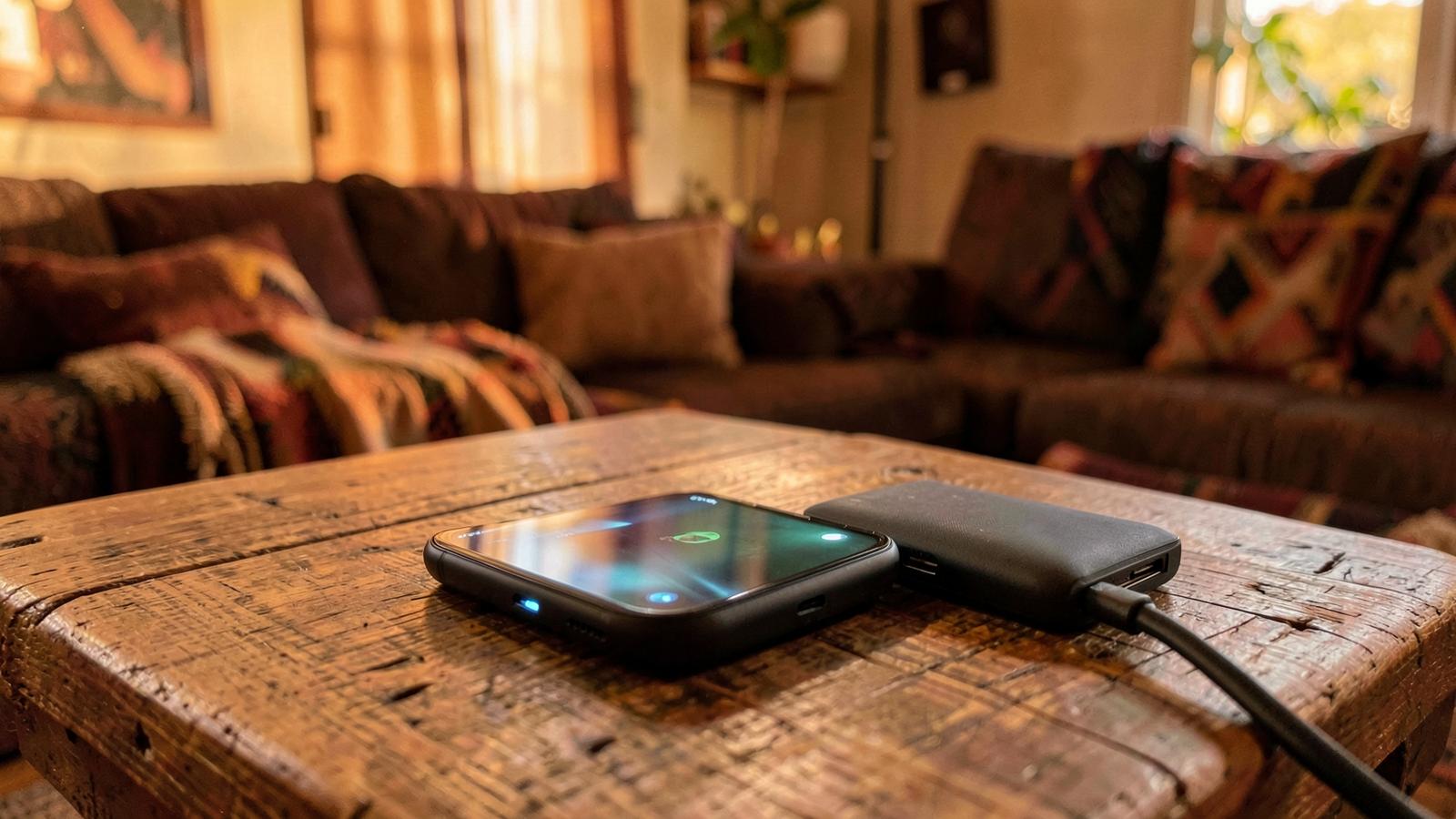
Apple does not include a charger in the box. To hit the 15-minute-to-50% figure you need a decent USB-C power adapter. A weak charger still works, just slowly.
Fast charging in short windows is the real win. If you get light for 20 minutes, a fast charger gets you to roughly half. That behaviour is worth more in Nigeria than any endurance rating.
Wireless charging is convenient, not efficient. It generates more heat and takes twice as long to reach 50%. In a hot room, prefer the cable.
Heat is the enemy of battery health. Charging a phone in direct sun, on a car dashboard or under a pillow shortens its life. See heat and power conditions.
Our accessory picks — chargers, cables and the power bank capacities that make sense — are in best chargers and power banks for the iPhone 18 Pro.
Habits that add hours
- Turn on the battery health features in Settings and let the phone manage charging overnight
- Cap charging at 80% on days when you know you will be near power
- Drop from 5G to LTE when you are in a weak-signal area and only need WhatsApp
- Lower the screen brightness — a 120Hz OLED at full brightness in sunlight is the biggest single drain
- Keep the phone out of your pocket while it charges
Perspective: battery on a Nigerian budget
Here is the thing nobody selling flagships will tell you. Battery life is the one specification where cheap phones compete on equal terms — plenty of phones under ₦300,000 ship with far larger batteries than any iPhone, because they are thicker and their screens are less demanding.
If all-day battery is your priority rather than the camera, look at best battery phones in Nigeria and phones under ₦300,000 first. You may find you have been shopping for the wrong thing.
Price note: Nigerian iPhone 18 Pro quotes of about ₦2.5 million (Pro) and ₦2.9 million (Pro Max) are retailer estimates dated 10 September 2026.